The year shipping hit the decarbonisation crossroads - and how 2026 could decide the route ahead
If 2024 felt turbulent, 2025 proved that volatility is now the shipping industry’s new normal.
For those of us responsible for developing the engines that power the global fleet, one conclusion stands out: in the absence of global policy, industry momentum is critical. Decarbonisation will only succeed if the entire maritime ecosystem—fuel suppliers, shipyards, class societies, technology providers, and ship owners and operators—moves forward together, aligned behind practical, scalable solutions.
At WinGD, our responsibility is clear. We must ensure shipowners have propulsion systems that are efficient, safe and reliable, whichever fuel pathway they choose to reduce their emissions. And we will continue to work with operators to build the experience needed to encourage wider uptake of the solutions that enable maritime decarbonisation.
With this momentum, we can trigger faster scaling of green fuels and technologies, make the energy transition ever more feasible, and increase the appetite for a regulatory regime that incentivises proven, available steps to reduce emissions to net-zero.
IMO hits pause but the carbon clock keeps ticking
The decision in October to delay adoption of IMO’s Net Zero Framework (NZF) may have slowed regulatory clarity, but it didn’t stop the carbon clock. The industry is still marching towards the IMO’s 2030 checkpoint of a minimum 20% GHG reduction, on the road to net zero by or around 2050.
Near-term, that means LNG—and perhaps ethanol, emerging as a new marine fuel candidate this year—are among the most cost-effective fuel choices for operators. The green fuels that could enable deeper emissions reductions remain unaffordable for companies that are not able to leverage scale or otherwise invest deeply in supply chains to reduce their cost.
Our customers are ready to act. But without clear financial incentives and predictable rules, the premium paid for green methanol and ammonia remains difficult to justify for many. Fuel producers face the same challenge, leading to slow progress scaling production.
But as our efforts this year show, we cannot wait for regulation. Incentives may be an essential element of the decarbonisation recipe, but operational experience with new fuels is also a vital ingredient. We have been fortunate to partner with pioneering companies who also recognise this fact. Together, we remain committed to showing just how green fuels can be used in real-life operations.
Methanol takes off. Ammonia arrives. Ethanol follows.
While policy paused, we did not. We started 2025 with the delivery of our first methanol engine, X-DF-M, a large-bore design that immediately attracted strong market interest, with nearly 100 more methanol engines now on order.
Then, in July, we achieved a major industry milestone: the delivery and installation of our X-DF-A engine on an EXMAR LPG carrier, the first ammonia-fuelled marine two-stroke installation on a vessel. Our testing indicates a cut in tank-to-wake emissions by up to 95%. This and further vessels with ammonia-fuelled engines will enter operations in 2026. Our more than 30 further ammonia engine orders highlights that, while we remain in regulatory doldrums, the appetite for green fuelled vessels remains strong.
We rounded the year out with the launch of X-DF-M/E, bringing the potential for ethanol-optimised capability to our successful methanol platform, ready for first deliveries in 2027. With very low fuel prices in some markets and significant greenhouse gas emissions reductions, ethanol has the potential to rise rapidly as a fuel option in its own right or as a means of making green methanol operation less expensive.
As a result of these efforts, shipowners can see a practical pathway toward a fossil-free future not just in laboratory tests, but on the water.
Retrofits and service: decarbonisation that lasts
Most vessels trading in 2030 – and well beyond – are already in operation, which is why we see retrofits emerging as a defining theme of 2026. Upgrading engines to improve efficiency and enable fuel flexibility offers a pragmatic, cost-effective way to reduce emissions now, rather than waiting years to improve emissions through fleet renewal.
This year we demonstrated this potential by converting three diesel-only engines to methanol – a first-of-its-kind example of how existing assets can be repositioned for a low-carbon future. Our first retrofit of Variable Compression Ratio technology, delivering further emission advantages and methane slip reduction for LNG-fuelled X-DF engines, was also concluded successfully on a vessel operated by CMA CGM.
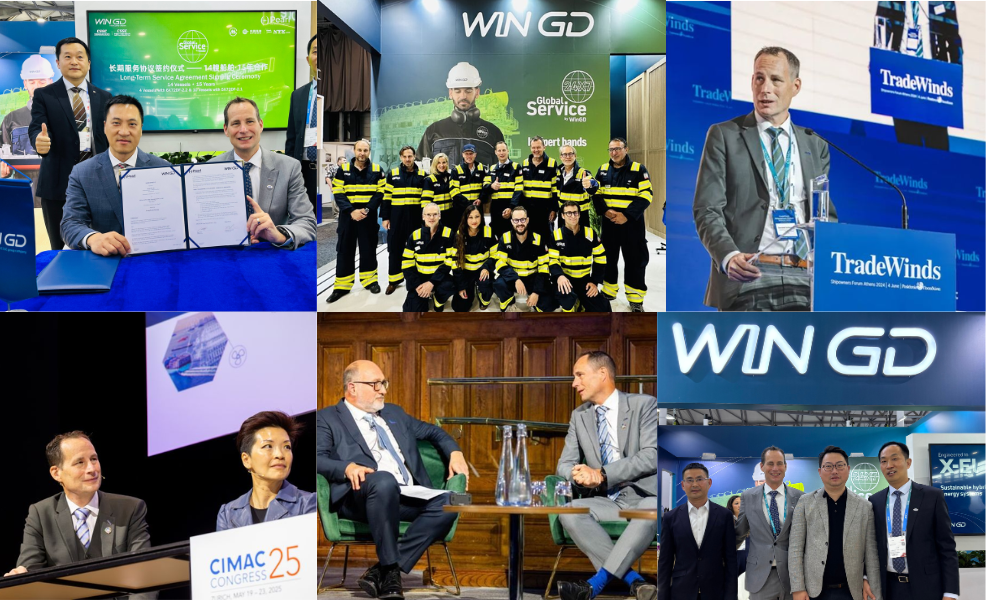
Alongside retrofits, we launched Global Service by WinGD, marking another major milestone. This expanded service offering extends parts supply, in-service support and technical advisory across the entire vessel lifecycle, helping operators maintain optimal efficiency, maximise asset value and extend compliant operating life.
The signing of a long-term service agreement with OPearl LNG Ship Management, and our commitment to open a service centre with Qatar Shipyard Technology Solutions to serve the regional LNG carrier fleet, underline the strength of this approach.
Retrofits enable the transition – service ensures it endures. This is why WinGD is ramping up its regional presence, ensuring that its technical expertise is available to ship operators wherever needed. Decarbonisation does not end at delivery; it depends on sustained performance at sea.
Meet the powerhouse: much-welcomed choice for the ULCV segment
Customer demand shaped our year, culminating in one of our most significant product launches to date: the X-DF-HP, our first high-pressure LNG dual-fuel engine, created specifically for ultra-large container vessels (ULCVs).
ULCVs demand extraordinary power density and efficiency. The X-DF-HP delivers both. With Tier III compliance in gas and diesel modes using only a standard SCR, the solution offers straightforward shipyard installation as well as a clear step up in fuel efficiency compared to other high-pressure engines on the market.
2026: a year to regain momentum
Looking ahead, we expect 2026 to be a year of continued innovation, opportunity and progress. Our new LNG portfolio means owners and operators will reap the highest possible benefits from the fuel, ready for a seamless transition to bio- or synthetic methane as needed. And the operational experience we and our shipowner partners gain using ammonia, methanol and ethanol engines will forge a path for the rest of the industry.
When regulatory clarity comes, the decarbonisation drive will accelerate quickly. Our mission is to ensure shipowners are ready for that moment, with propulsion solutions that keep fleets compliant and competitive in an uncertain world.
The technology is ready. The industry is ready. Now is the time for leadership to show the way ahead.